Joyce Ng shows us the commuter through the eyes of machines
Artists, Case Studies | Published on | Last updated on
3 min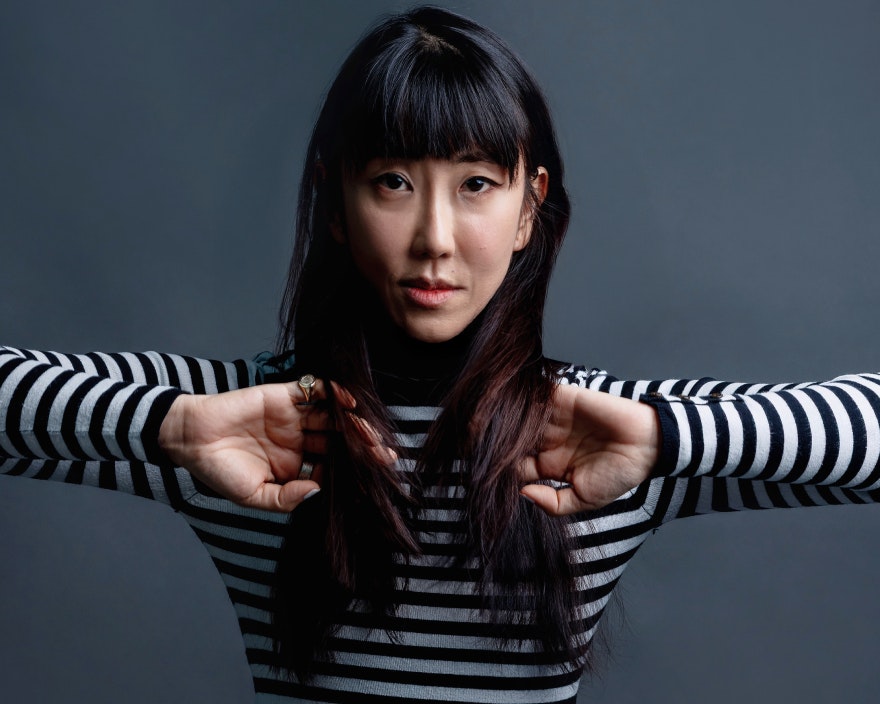
For Human Error Rate, Joyce took videos of commuters from around the world and prompted an AI model to mirror their behavior
Meet the artist
Under the name alsoguppyme, Joyce creates work that transforms the ordinary into the surreal. As an AI artist, she doesn’t want to use technology to escape reality or smooth it over. The way she sees it, technology can be used as a tool for us to look more closely at the world we already live in.
Before she started working with generative AI, she trained as a painter and spent decades working in commercial creative roles. As an artist, she’s always been eager to explore and iterate with all the tools at her disposal. And this curiosity continues to shape how she works in the AI art space today.
“I started putting work out there, and somehow it became natural—something I couldn’t stop doing.”
Human Error Rate grew out of Joyce’s own experience with commuting. When she was fifteen, she crossed the Malaysia–Singapore causeway every day to get to school. The journey was slow and crowded. People stood shoulder to shoulder for hours
“That sea of helmets on the causeway is something I still can’t shake off.”
For Joyce, she sees trains and subways as places where people stop performing and disappear into themselves. These quiet moments of everyday behavior became the starting point for Human Error Rate.
“The side-by-side, before-and-after format is simple, but it’s powerful—it starts a conversation without being didactic.”
Inside the creative process
Each work in Human Error Rate is presented in two parts. One shows the original human footage. The other shows how an AI system interprets that same moment. Joyce chose this structure for its clarity. Placed side by side, the contrast makes the gap between everyday human behavior and machine perception immediately visible.
To create the work, Joyce moved fluidly between Leonardo and other tools, pushing images through different states—still frames into motion, motion into 3D forms, and back again. The process was intentionally exploratory.
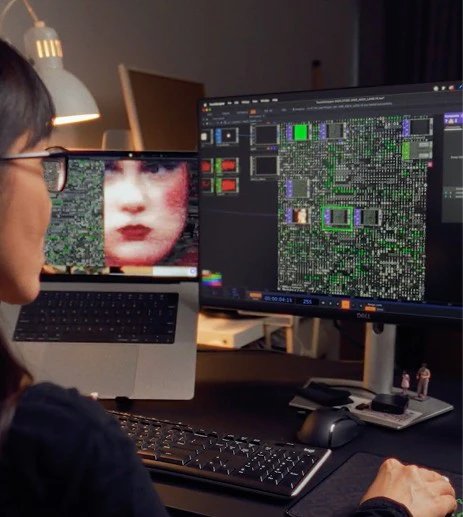
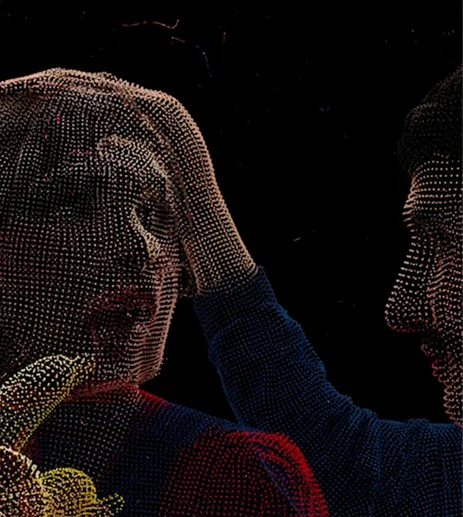
I don’t want to be didactic. I don’t want to tell people what to think. They can take it as entertainment or they can sit with it and ask questions. My role is just to share what I’m seeing.
Sometimes the AI model captured movement with precision. Other times, it fell apart. For Joyce, these weren’t technical errors. They were insights into how machines see the world.
Pushing their craft forward
Joyce is careful not to frame Human Error Rate as a story about humans versus machines. What she’s drawn to instead are the moments when AI systems mimic human behavior in an entirely unexpected way
“This isn’t AI versus human or AI bashing. It’s about asking how much AI truly understands us.”
By focusing on ordinary moments, Joyce invites viewers to consider how easily the human experience can be reinterpreted when people are reduced to data. In showing this, Human Error Rate reflects how Joyce sees art as a way of paying attention.
Watch: Human Error Rate
. . . .
RelatedArticles

Ivona Tau reconstructs her family history using AI tools
For her Imagination Fund project, Ivona used her grandfather’s archival 8mm footage to reconstruct her family’s past using AI tools. Ivona Tau is a new media artist from Vilnius whose work examines memory, nature, and perception. With AI as a tool in her practice, she uses code and machine learning to revisit the architecture of […]
Lucas Clément is building his dream world
For his Imagination Fund project, Lucas expanded Anotherworld into a cinematic short film with a 360° VR experience built from the project’s core imagery. Based just outside of Paris, Lucas is the creator of AnotherWorld. In this surreal world on social media, he invites his audience to explore dreams and all emotions they evoke. To […]
2026’S POWER LIST: TOP 50 WOMEN AI FILMMAKERS
Mia Forrest uses technology to reflect nature’s algorithms
For Orchids, Mia uploaded images from the National Herbarium of New South Wales into an AI model to generate new species of AI-grown orchids Mia Forrest is an Australian multidisciplinary artist with work presented by Sotheby’s and Unit London. She works from her studio in Byron Bay near the rainforest and likes to stay close […]